News for Aztec Parents
— Spring 2025 Issue, News for Aztec Parents
New Sculptures Bring to Life Kumeyaay Stewardship History, Living Land Acknowledgement
By Rafael Avitabile
The Living Land Acknowledgment sculpture series at San Diego State University brings to life the university’s Kumeyaay Land Acknowledgment, which is traditionally recited at convocation, commencement and other major university events.
This formal statement recognizes and respects Indigenous peoples as traditional stewards of the land the university now occupies. Stuart Voytilla, faculty lead of the SDSU Story Lab, said the sculpture project is a way to bring the words of the Land Acknowledgment to life in the physical and virtual spaces, while bringing Native artwork to more prominent places at SDSU.
Together, the Native Resource Center, SDSU Story Lab, the Virtual Immersive Teaching and Learning Research Center and the Division of Student Affairs and Campus Diversity turned the idea into reality, cementing or, in this case, bolting to the ground, an educational art experience representative of the relationship shared by SDSU and the Kumeyaay.
The Living Land Acknowledgment sculptures were designed by Kumeyaay artist Johnny Bear Contreras.
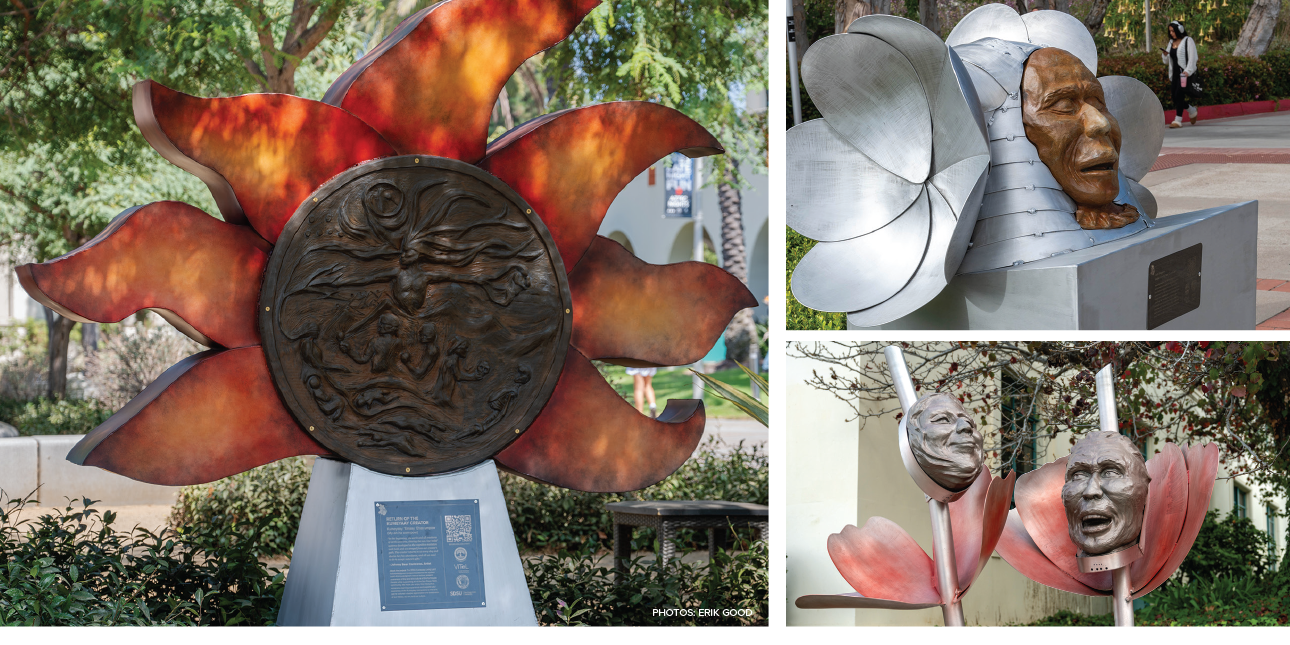
The Living Land Acknowledgment series was formally presented to the SDSU community last fall with a gathering and unveiling of the series’ third sculpture, “Return of the Kumeyaay Creator” in Sickels Plaza.
“Our spoken Land Acknowledgment is an essential practice of gratitude to the Kumeyaay, but is it sufficient for a lasting, present awareness of the Kumeyaay culture and the history of this land?” Voytilla said then.
“I’m grateful for the opportunity to work with the Kumeyaay to transform space and spoken word into a physical and virtual immersive, interactive celebration of their culture,” he said.
“This project helps tell our stories, which we have kept alive since time immemorial. It’s a testament to our sustainability as humans. To recognize and honor that, and bring that recognition into a university setting, is important for Native students developing a sense of belonging on campus.”
For now, the series features three bold and unmistakable statues on the San Diego campus, with plans for the next sculpture project to be brought to SDSU Imperial Valley. Each piece has an attached QR code that brings onlookers into an immersive, “living” extended reality lesson on the culture, customs or history of the Kumeyaay people.
Jacob Alvarado Waipuk, chair of tribal relations at SDSU and an SDSU alumnus, reminisced about his semester abroad at the University of British Columbia in Canada, where totem poles around campus celebrated the First Nations of the Pacific Northwest. When it came time to imagine the Living Land Acknowledgment, he knew the profound impact the project could have on Native students.
“This project helps tell our stories, which we have kept alive since time immemorial. It’s a testament to our sustainability as humans. To recognize and honor that, and bring that recognition into a university setting, is important for Native students developing a sense of belonging on campus,” Waipuk said.
Derrick Herrera, SDSU Associated Students’ vice president of external relations and member of the Kumeyaay and Luiseño communities, said “Return of the Kumeyaay Creator” represents the Kumeyaay philosophy, “In the beginning, the earth and all creatures of earth were one, sharing the sun.”
“The unveiling of this sculpture is not just a celebration of art; it is also a call to action. It invites us to reflect on our relationship with communities who have cultivated the land we stand on,” Herrera said.
Project organizers collaborated with students involved with the NRC to identify high-traffic areas where the artwork could share space with well-known landmarks.
The first installation in the Living Land Acknow-ledgment was “Stargazer,” installed in March 2024 near the Koester Memorial Sundial in front of Hepner Hall. Its focal point is a man’s face angled up at the sky, perfectly positioned to do as its title suggests.
The man’s eyes are closed, expanding his field of vision beyond what is here and now, leaving nothing between him and the stars that have also been present since time immemorial — and will remain far beyond our lifetimes. The man’s state of mind, not in the past, present or future, but in a different place altogether, is an important element of the first piece of the series, according to Contreras.
Attached to “Stargazer” is a QR code that, when scanned, presents an immersive virtual performance of a Kumeyaay bird song by Blue Eagle Vigil and his daughter, Lovely Vigil. Bird songs are a rich and important component of storytelling and legacy-keeping in the Kumeyaay culture.
“People of the Sun” came next, about 100 yards away from “Stargazer.” The sculpture stands parallel to a statue of SDSU’s first president, Samuel T. Black, beneath the shade in the North Library Quad. There are two faces, a man and a woman, with delighted expressions emerging from blooming poppies. Their faces are suspended by the stem of the poppy, which grounds them to Mother Earth. The woman’s face is elevated higher than the man’s as an homage to the “life-givers,” Contreras said.
A scan of the second statue’s QR code will initiate an augmented reality experience featuring a recital of the Land Acknowledgement by its author, Mike Connolly Miskwish.
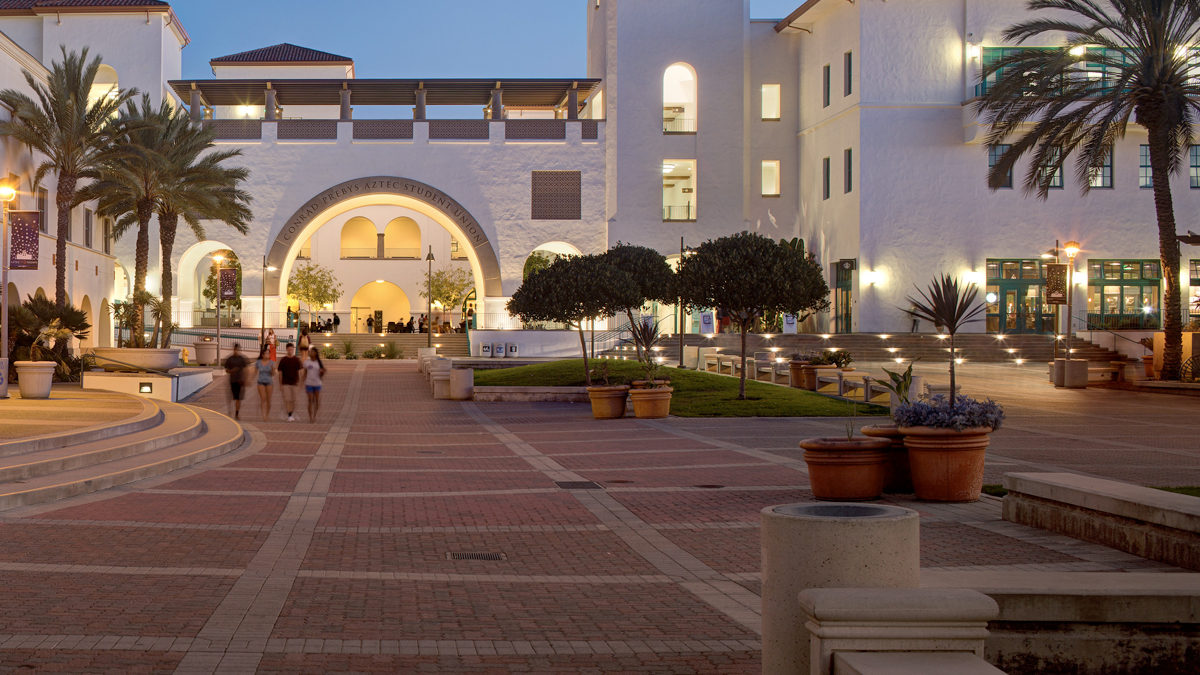
“Return of the Kumeyaay Creator” is found in Sickels Plaza along Centennial Walkway, north of the Conrad Prebys Aztec Student Union. The piece represents the story of Maayhaay, the Creator God Spirit, whom the Kumeyaay believe created the earth.
Its QR code takes viewers to a 360 video of Contreras discussing elements of the design, and the creation story that inspired it, from his studio workshop. SDSU’s Living Land Acknowledgement is inspiring other campuses to reimagine their own land acknowledgments. Voytilla said several universities have been in contact for advice and to draw inspiration for similar projects.
“We have an incredible responsibility to educate others about the history of Native and Indigenous peoples and to speak about the ongoing contributions of the Kumeyaay and other Native people to our campus,” said SDSU President Adela de la Torre.
“The Living Land Acknowledgment is a beautiful, artistic way of bringing people into that discussion, while also presenting the ethos of SDSU’s very sincere land acknowledgment statement into a format that is both engaging and educational,” she said. “It’s another step in our ongoing commitment to partnership and collaboration with Native communities.”
As of spring 2025, you can check out Living Land Acknowledgment artwork in front of Hepner Hall, in the North Library Quad and at Sickels Plaza. More art is planned at SDSU and SDSU Imperial Valley.